Updated October 2026
Quick answer: SEO (search engine optimisation) helps your website rank in Google and Bing search results. AIO (AI optimisation, also called AEO, GEO or LLMO) helps AI assistants such as ChatGPT, Claude, Google Gemini, Google’s AI Overviews, Copilot and Perplexity understand, trust and cite your business in their answers. You don’t need to choose: good SEO is the foundation of AIO, and most businesses should do both.
Search is changing. For years, SEO has been the main way to get found online. Now many people ask an AI assistant instead, and get a single summarised answer with a handful of cited sources rather than ten blue links. Here’s a plain-English guide for busy owners and managers.
What is SEO?
SEO is the set of practices that help your website appear prominently in traditional search results. The goals are to rank higher, earn more clicks and turn those visits into enquiries and sales. It covers relevant content, a sensible site structure, page speed, mobile-friendliness, local listings and links from reputable websites.
What is AIO?
AIO is about being found and trusted when an AI does the searching for your customer. It focuses on making your business and information clear, consistent and machine-readable, so assistants are confident including and citing you.
You’ll also see it called:
- AEO: answer engine optimisation
- GEO: generative engine optimisation
- LLMO: large language model optimisation
What about the AI summaries at the top of Google?
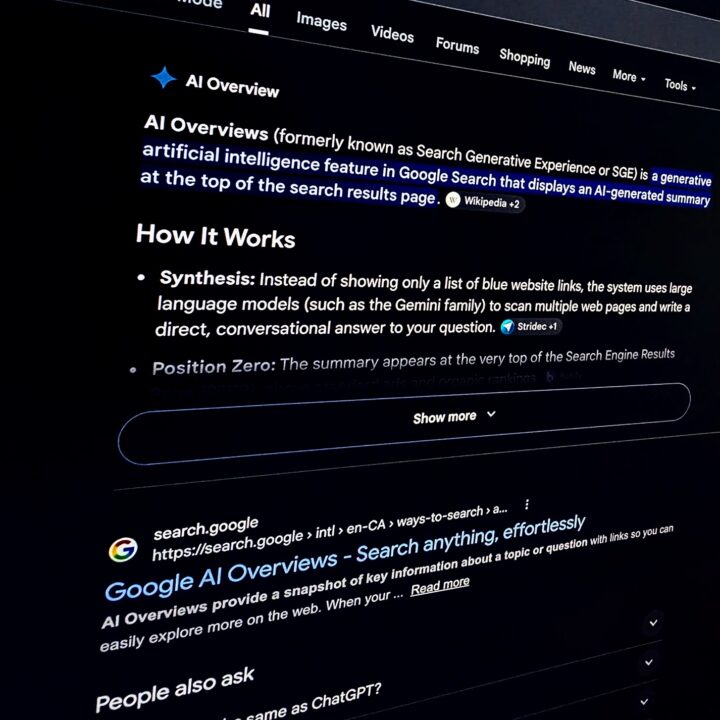
Those are Google’s AI Overviews: a short AI-written answer above the normal results, with links to the pages it drew from. Bing shows similar Copilot summaries. For many questions, people now read that summary and never scroll to the blue links.
AI Overviews sit where SEO and AIO meet:
- They’re built from Google’s own index. Google mostly draws on pages that already rank well for the question, so strong SEO comes first.
- They favour pages that answer clearly. A direct answer near the top of the page, clear headings and short, quotable facts make your page easier to cite.
- There’s no separate opt-in. If Googlebot can crawl and index your page, it’s eligible. Blocking Google’s AI training crawler (Google-Extended) doesn’t remove you from AI Overviews.
- Being cited beats being skipped. Fewer people click through when the answer is on the results page, so the link inside the summary is the one worth winning.
For a step-by-step guide, see how to get your business cited in Google’s AI Overviews.
SEO vs AIO: the key differences
| SEO | AIO | |
|---|---|---|
| Where you appear | Search results pages and Google Maps | AI answers, AI Overviews, chat assistants and voice assistants |
| Best content format | In-depth pages that match what people search for | Clear, quotable facts: short answers, FAQs, lists and tables |
| Signals that matter | Relevance, quality, technical health, links | All of those, plus structured data, consistent facts across the web and visible expertise |
| Trust | Authority, links and reviews | Trust that machines can verify: named authors, About pages, policies, consistent business details |
| Freshness | Helps | Often decisive; assistants prefer current, specific information |
Where they overlap
Both reward genuinely helpful content, fast and accessible websites, mobile-friendly design and a strong, recognisable brand. If you’ve invested in SEO foundations, you’re already halfway to AIO. AIO simply asks: could an AI confidently lift this information and present it to a customer, with us cited as the source?
A practical playbook for small and medium businesses
SEO essentials
- Own your topics, not just keywords. Answer the questions customers ask before and after they buy: problems you solve, timelines, comparisons and what’s included.
- Get the basics right on every page: clear titles and headings, descriptive meta descriptions, internal links and optimised images.
- Local visibility: keep your Google Business Profile complete and accurate, and collect and respond to reviews.
- Links and mentions: earn genuine references from partners, industry bodies, sponsorships and case studies.
- Technical health: make sure your pages can be indexed. See why pages aren’t being indexed by Google.
AIO upgrades
- Add FAQs to key pages, with direct, one or two sentence answers.
- Use structured data (schema.org) for your organisation, services, FAQs, articles and locations, so machines can read your key facts.
- Publish facts in tidy formats: opening hours, service areas, processes and specifications in lists or tables.
- Show real people: named authors with roles and experience, and an About page that explains who you are and why you’re qualified.
- Keep details consistent everywhere: website, Google Business Profile, social media and directories.
- Create source-worthy content: how-to guides, checklists, calculators and case studies with real outcomes.
- Avoid PDF-only content. Publish important information as a web page as well.
- Put dates on your articles and keep them up to date. See why so many articles hide the date.
How to measure success
SEO: organic impressions and clicks, rankings for key pages, local map visibility and enquiries from organic traffic.
AIO: how often your business is mentioned or cited when you ask assistants your customers’ key questions, referral traffic from AI tools (Google Analytics 4 can show some of this), and enquiries where people say they found you through an AI assistant.
AI Overviews: search your key questions in Google, note which ones show an AI Overview, and check whether your site is one of the cited sources. Search Console includes AI Overview appearances in your normal Performance data.
What should you prioritise?
Most small and medium businesses do well with a blend: roughly 70% SEO foundations and 30% AIO upgrades. If your information changes often (prices, events, stock), lean more towards AIO, because clear, fresh facts pay off quickly in AI answers.
Quick-start checklist
- Turn your top five service pages into question-and-answer-rich pages (three to eight FAQs each).
- Add Organisation, LocalBusiness, Service and FAQ structured data.
- Publish one genuinely useful guide, checklist or case study each quarter.
- Make your business name, address and phone number consistent everywhere.
- Write down ten questions you must be found for, and check each month whether AI assistants cite you.
Frequently asked questions
Is SEO dead because of AI?
No. AI assistants rely heavily on the same signals search engines use, and many of them draw on search results. Strong SEO makes you more likely to be cited by AI.
Can I pay to appear in ChatGPT or AI Overviews?
Not in the same way as paid search ads. Appearing in AI answers comes from being a clear, trusted and consistent source.
How long does AIO take to work?
Like SEO, it takes months rather than weeks. Structured data and clear FAQs can help relatively quickly; brand trust builds over time.
Want to be found in search and AI answers?
Itomic combines web development with hands-on SEO, Google Ads and AI search optimisation for Australian businesses and organisations. Talk to us about where you’re showing up, and where you’re not.