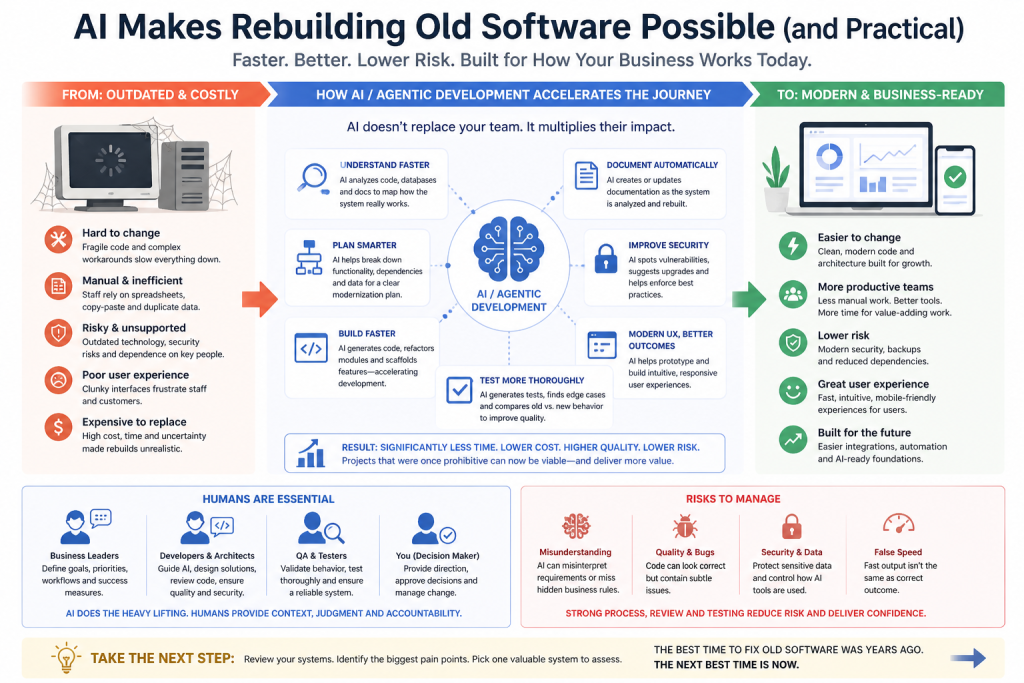

 Many businesses are still running on old software.
Sometimes it is a public-facing web application. Sometimes it is a customer portal, booking system, CRM, intranet, reporting dashboard, stock system, membership database, or a set of internal admin tools that staff use every day. Often it was built years ago by a developer or agency that has since moved on. It may still “work”, but only just.
For a long time, business owners and managers have tolerated this situation because the alternative felt too expensive, too risky, or too disruptive.
Rebuilding old software used to mean months of planning, large development budgets, uncertain outcomes, and the uncomfortable possibility that the new system might not fully replicate the business rules embedded in the old one. As a result, many companies simply patched and patched again, even when everyone knew the system was becoming a liability. Or they didn’t patch at all.
AI-powered and agentic software development is beginning to change that equation.
This does not mean that AI magically replaces experienced software developers. It does not mean every old system can be rebuilt overnight. But it does mean that many software upgrade and rebuild projects that previously felt commercially unrealistic are now becoming viable.
For business leaders, this is an important moment to reassess the older software your organisation depends on.
Why old software becomes a business problem
Older software rarely fails all at once. More often, it becomes a drag on the business gradually.
Staff develop workarounds. Reports take too long to produce. Data is exported to spreadsheets because the system cannot do what people need. Customers struggle with clunky online processes. Integration with newer services becomes difficult. Security updates become harder. Developers become reluctant to touch fragile code because one small change may break something unexpected.
The business may also become dependent on a small number of people who understand how the old system works. That creates operational risk. If those people leave, retire, or are unavailable, the business may have a serious knowledge gap.
For web-based systems, the problem can be especially visible. Customers now expect fast, mobile-friendly, secure, easy-to-use online experiences. A dated web application can quietly damage trust, conversion rates, staff productivity, and customer satisfaction.
Until recently, the problem was obvious, but the solution was often painful.
What AI changes
Modern AI development tools can assist with many parts of the software lifecycle: understanding old code, mapping functionality, generating documentation, suggesting modern architecture, writing new code, creating tests, finding bugs, producing user interface prototypes, and helping developers move faster through repetitive tasks.
Agentic development takes this further. Instead of simply answering questions, AI agents can be given goals and asked to work through multi-step tasks: inspect a codebase, identify dependencies, summarise how a feature works, generate a migration plan, create a test suite, refactor a module, or build a first version of a replacement feature.
In practical terms, this can significantly reduce the time needed to understand and rebuild older software.
One of the biggest historical costs in a rebuild project was discovery. Developers had to spend a long time working out what the current system did, where the important logic lived, what data structures existed, and which features were actually used. AI can now help accelerate this process. It can read large amounts of code, database schema, configuration files, documentation, support notes, and user stories, then produce a structured picture of the system.
That does not remove the need for expert review, but it can shorten the path from “we have no idea how this old system really works” to “we have a workable map of what needs to be preserved, improved, retired, or rebuilt.”
Faster does not only mean cheaper
Speed is an obvious benefit, but it is not the only one.
AI-assisted development can also improve quality when used properly. It can help produce more consistent code, generate automated tests, identify edge cases, suggest security improvements, and compare old and new behaviour. For older systems with little or no documentation, AI can help create documentation as part of the rebuild process.
This matters because a good rebuild is not just about recreating what already exists. It is an opportunity to ask better questions.
Which features are still needed? Which processes are inefficient? Which data should be cleaned up? Which manual steps could be automated? Which customer journeys could be improved? Which reports should be available instantly? Which parts of the system should integrate with accounting, email, CRM, payment, analytics, or AI services?
The opportunity is not merely to replace old software. The opportunity is to modernise how the business works.
Why simpler systems are the best place to start
The best candidates for early AI-assisted rebuilds are usually smaller, well-bounded systems.
For example, an old internal web application that manages bookings, forms, records, documents, customer enquiries, stock, jobs, memberships, or reporting may be an excellent candidate. These systems often have clear business rules, familiar workflows, and a manageable database structure.
The more complex the old system, the more care is required. Large, highly customised software with years of hidden business logic, multiple integrations, poor data quality, and many user groups cannot simply be thrown at an AI tool and safely rebuilt.
However, this boundary is moving quickly. AI tools are improving at working with larger codebases, longer context, more complex instructions, and more sophisticated testing workflows. What was unrealistic two years ago may be practical now. What is difficult now may become routine in the next few years.
That is why business leaders should not dismiss the opportunity just because a previous rebuild quote was too expensive or too risky. The economics may have changed.
Humans are still essential
AI is powerful, but it still needs human direction, judgement, and accountability.
Business people are needed to explain what the software is supposed to achieve, which workflows matter, what frustrates users, which reports are important, and where the current system creates risk or waste.
Technical people are needed to review AI-generated work, make architecture decisions, handle security, manage data migration, test integrations, and ensure the system is reliable, maintainable, and fit for production.
A good prompt engineer, developer, or technical lead can use AI as an accelerator. They can break work into well-defined tasks, check outputs, challenge assumptions, and prevent mistakes from reaching live users.
The best results come from a human-in-the-loop approach: AI does the heavy lifting where it is strong, while humans provide context, judgement, testing, and approval.
Risks and downsides
There are risks.
AI can misunderstand requirements. It can produce code that looks correct but contains subtle bugs. It may miss hidden business rules. It may suggest an approach that is technically plausible but not appropriate for the specific business. It can also give a false sense of progress if nobody is carefully validating the work.
Security and data privacy must also be handled properly. Businesses need to be careful about what source code, customer data, credentials, and commercial information are shared with AI tools. The right development environment, permissions, backups, and governance matter.
There is also a project management risk. Because AI can generate code quickly, teams may rush into building before they have properly understood the business process. Fast output is not the same as correct output.
These risks are manageable, but they should not be ignored. AI reduces friction, but it does not remove the need for discipline.
What business leaders should do next
The practical first step is not to commission a full rebuild immediately. It is to take inventory.
Look across your business and identify the software that staff complain about, the systems that are hard to change, the tools that rely on manual workarounds, and the web applications that customers find awkward or outdated.
Then ask:
Which systems create the most daily frustration?
Which systems would be expensive or damaging if they failed?
Which systems are holding back growth?
Which systems contain valuable data but make it hard to access or use?
Which customer-facing tools make the business look less modern than it really is?
Which processes could be simpler, faster, or more automated?
From there, choose one realistic candidate for assessment. Not necessarily the biggest system. Often the best starting point is a smaller but valuable piece of software where the business benefit is clear and the risk is manageable.
AI-powered development is not a magic wand. But it is a major shift in what is now possible.
For many businesses, the old assumption was: “We know this software needs replacing, but it is too expensive and risky.”
The new question is: “Given what AI-assisted development can now do, is this still too expensive and risky, or has the moment arrived to finally fix it?”
For many older systems, especially web-based business software, the answer may have changed.